100 AI Agents Per Employee: What Jensen Huang's Vision Actually Looks Like in Practice
Last week at GTC 2026, Jensen Huang told the world that Nvidia will have 7.5 million AI agents working alongside 75,000 humans by 2036. That's 100 agents per employee. McKinsey already claims 25,000 agent “employees.” The headlines wrote themselves.
I run 13 AI agents today. Not in a demo. Not in a pitch deck. In production, on a single VPS, handling real work across my company and side projects. I built LEO:AI — the agent system behind openLEO — specifically to solve the problems Huang is talking about. Here's what the discourse is getting wrong — and what it actually takes to operate a multi-agent system.

Reza Rezvani
CTO & Founder, openLEO · Creator of LEO:AI · 22 years in engineering leadership
In this article
What Jensen actually said
Let's start with the exact quote. At a GTC media Q&A, Huang said:
“In 10 years, we will hopefully have 75,000 employees, as small as possible, as big as necessary. They're going to be super busy. Those 75,000 employees will be working with 7.5 million agents.”
— Jensen Huang, GTC 2026 Media Q&A
On the All-In Pod, he went further — proposing that engineers receive “AI tokens” on top of their salary. A $500K engineer would be evaluated not just on their output, but on how much they spent in tokens — effectively making AI compute a line item in every engineer's compensation.
This isn't science fiction. McKinsey already reports 25,000 AI agents working alongside 40,000 humans. Accenture's CEO says failure to adopt AI could cost workers a promotion. The question isn't whether this future arrives. It's whether you'll be ready.
7.5M
AI agents Nvidia plans by 2036
100:1
Projected agent-to-human ratio
25,000
AI agents McKinsey runs today
The gap between vision and reality
Here's what the conference keynotes skip: running agents is nothing like running software.
Software does what you tell it. Agents reason, plan, and take actions autonomously. A broken API call throws an exception. An agent reasoning failure produces confident, plausible output that's completely wrong — and there's no error log to catch it.
As Arize AI put it this week: “The most expensive failures aren't crashes or hallucinations caught at the surface. They're silent errors that get picked up by the next agent in the pipeline and amplified before anyone realizes something went wrong.”
This is the real governance gap. And it's the thing nobody on stage at GTC talked about. It's also the reason I spent the last year building a system that handles this — but more on that later.
What 13 agents in production actually looks like
I've been running a multi-agent system for months — not at Nvidia scale, but with enough complexity to see the real challenges. This system is called LEO:AI, and it's the engine behind openLEO. Here's the setup:
LEO:AI production stack
13 specialized agents
Running on OpenClaw — CTO, CPO, content, dev, security, and more
25 automated cron jobs
Email triage, calendar, GitHub, competitive intel, content pipeline
Single VPS — 8 vCPU, 16GB RAM
Everything on one server. Total infra: ~€75/mo
Persistent memory layer
Each agent has its own context, decisions log, and learned preferences
Multi-channel access
Telegram, Slack, email — all connected. Talk to your agents anywhere.
192 installable skills
From SEO to ISO 27001 compliance — agents gain expertise instantly
The agents aren't generic chatbots. Each has a specific role — and in LEO:AI, each one has its own avatar identity:

CTO Agent
Reviews architecture decisions, tracks technical debt, monitors CI/CD

CPO Agent
Analyzes product metrics, surfaces user feedback, prioritizes backlog

Content Agent
Monitors trends, drafts articles, manages the publishing pipeline

Dev Agent
Code reviews, deployment coordination, incident triage

Security Agent
Vulnerability scans, compliance checks, access audits

Research Agent
Competitive intelligence, market analysis, pre-meeting briefings
Plus 7 more — CMO, CFO, QM, PM, COO, clinical, and a main orchestrator — each with defined scope, tools, and escalation rules.
Total monthly cost for infrastructure: about €75. Add AI provider tokens and you're looking at €150–300/month depending on usage.
€150–300
13 AI agents / month (infra + tokens)
€3,000–5,000
One junior hire / month (Germany)
The 5 things nobody tells you about running agents
Orchestration is everything
100 agents doing random things is worse than zero agents. The value comes from how they coordinate. In LEO:AI, the main agent routes tasks to specialists based on complexity, urgency, and domain. Without this orchestration layer, you just have 100 chatbots generating noise.
Jensen's vision assumes something like this exists at scale. Today, it barely exists at all. This is one of the core problems openLEO solves — your agents come pre-configured with orchestration rules, not just prompts.
Memory is the moat
The single biggest differentiator between a useful agent and a toy is persistent memory. My agents remember past decisions, learned preferences, project context, and recurring patterns. When my CTO agent reviews an architecture proposal, it knows what we decided last month and why.
Most AI tools — ChatGPT, Gemini, Copilot — start fresh every session. That's not an agent. That's a chatbot with amnesia. LEO:AI maintains structured memory files (MEMORY.md, daily logs, project contexts) that persist across every session. Your agent gets smarter over time.
Failures are silent and cascading
When Agent A produces a slightly wrong summary, and Agent B uses that summary to make a decision, and Agent C acts on that decision — you don't get an error. You get a confident, well-structured output that's built on a foundation of garbage.
At 100 agents, this isn't a theoretical risk. It's a Tuesday. LEO:AI addresses this with validation layers, escalation rules, and a “verify before acting” principle baked into every agent's operating instructions.
Privacy isn't optional — it's architectural
The moment your agent touches email, calendar, Slack, CRM, or customer data, you need infrastructure-level isolation. Not “we have a privacy policy” — actual dedicated servers, encrypted storage, no data mixing between users.
This is why openLEO runs each customer instance on a dedicated VPS. Customer workloads are separated by design. It's not a feature — it's the only responsible way to operate agents that have access to your business data. Read more about our approach in Privacy-First AI Assistant.
Skills make agents useful — not prompts
A prompt tells an agent what to do. A skill gives it the knowledge and tooling to actually do it well. The difference between a generic “write me an email” agent and one that knows your brand voice, formatting standards, and audience — that's the skill layer.
openLEO Professional and Business plans come with pre-built skill packages tailored for your role — founder, marketer, developer, ops lead. You don't start from scratch. You start with an agent that already knows your domain.
claude-skills — 192 skills, 4,900+ ★
The open-source skill library that powers LEO:AI agents. Works with OpenClaw, NemoClaw, Claude Code, Codex, Cursor, and 8 more coding agents. From CTO-level advisory to ISO 27001 compliance — install a skill, get an expert.
View on GitHubWhy I built LEO:AI

I didn't set out to build a product. I set out to solve my own problem.
As CTO of a healthcare AI startup in Berlin, I was drowning in operational overhead — email triage, CI monitoring, compliance tracking, content publishing, investor reporting. I needed leverage, but hiring wasn't an option. The team had shrunk from 12 to 5.5 people, and we had to do more with less.
So I started building agents. First one (email triage), then two (add calendar management), then five (GitHub monitoring, content pipeline, competitive intel). Within months, I had 13 agents running 24/7 on a single VPS, handling work that would otherwise require 2–3 junior hires.
That system became LEO:AI — and I realized the architecture could help anyone in my position: a founder, solopreneur, or small team leader who needs executive-level support but doesn't have executive-level budget.
openLEO is the platform that makes LEO:AI accessible. You don't need to know how to configure OpenClaw, manage a VPS, or write agent prompts. You sign up, choose a plan, and your dedicated agent is ready in minutes.
How openLEO works
openLEO is Agent-as-a-Service (AGaaS). That means you get a dedicated AI agent running on its own server, connected to your tools, with persistent memory — without managing any infrastructure yourself.
Configure
Pick a name, choose your AI provider (Claude, GPT, Gemini), set your preferences. Takes about 3 minutes.
Install skills
Choose from 192 pre-built skills or let openLEO recommend a package based on your role.
Go
Your agent deploys on a dedicated server. Connect via Telegram, Slack, or email. It's already working.
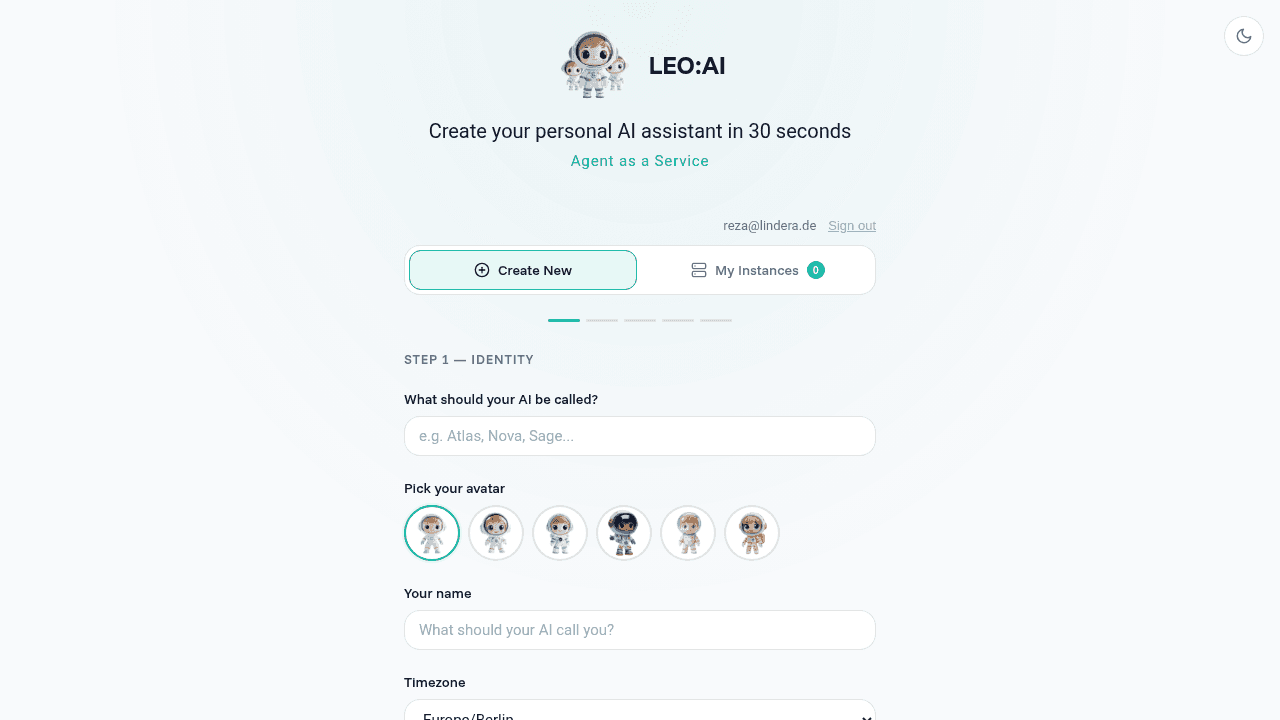
The openLEO setup wizard — pick a name, choose your AI provider, configure skills.
Under the hood, each openLEO instance runs on the same architecture I use daily: OpenClaw agent framework, persistent file-based memory, multi-channel messaging, automated cron workflows, and the full claude-skills library.
The key difference from other AI tools: your agent is dedicated. It runs on its own server, stores data only on your infrastructure, and doesn't share resources with anyone else. Learn more about the architecture on How It Works.
What every openLEO instance includes
Dedicated VPS
Your own server. No shared resources, no data mixing.
Persistent memory
MEMORY.md, daily logs, project context. Gets smarter over time.
Privacy-first architecture
Data stays on your server. GDPR-ready by design.
Automated workflows
Cron jobs, email triage, calendar management, CI monitoring.
192 installable skills
From SEO to ISO 27001 — install expertise in seconds.
Multi-channel access
Telegram, Slack, email, Discord — talk to your agent anywhere.
Any AI provider
Claude, GPT, Gemini, Ollama — bring your own keys, use any model.
Dedicated support
Professional & Business plans include direct support and SLA.
See openLEO in action
Explore the full platform — how the agent wizard works, what skills are available, and how pricing compares to alternatives.
The Nvidia + OpenClaw connection most people missed
Buried in the GTC announcements was something significant: Nvidia launched NemoClaw — a sandbox that runs OpenClaw inside Nvidia's OpenShell with policy-enforced network controls, managed inference via Nemotron models, and enterprise-grade security.
“Claude Code and OpenClaw have sparked the agent inflection point, extending AI beyond generation and reasoning into action.”
— Jensen Huang, Nvidia press release
This matters because it validates a specific architecture: open-source agent frameworks + sandboxed execution + configurable skills. Adobe, Salesforce, Palantir, SAP, and Cisco are all building on this stack.
LEO:AI and openLEO are built on the same foundation. When you launch an openLEO agent, you're getting the same Agent-as-a-Service architecture that Nvidia is betting their enterprise strategy on — without needing to set up OpenShell, configure Kubernetes, or hire a DevOps team. The same claude-skills library that powers LEO:AI is compatible with NemoClaw out of the box.
What “100 agents per employee” means for you
Let's translate Huang's vision from corporate keynote to practical reality. If you're a founder, solopreneur, or small team, you don't need 100 agents. You need the right ones.
Inbox Agent
Triages email, drafts replies in your voice, flags urgent items. You review and send — 90% less time in your inbox.
Calendar Agent
Schedules meetings, blocks deep work time, resolves conflicts, prepares meeting agendas automatically.
Research Agent
Pre-call briefings, competitor analysis, market research. Delivered before you need it.
Content Agent
Monitors trends, drafts articles, manages your publishing pipeline. Content without the grind.
Ops Agent
Tracks delegated tasks, sends follow-ups, generates weekly status reports across your projects.
Dev Agent
Monitors CI/CD, reviews PRs, surfaces deployment issues before they hit production.
Six agents. One person. That's not 100:1 — but it's enough to fundamentally change how you work. And unlike Nvidia's 10-year timeline, this is available today.
openLEO vs. doing it yourself
Can you build what I built? Absolutely. OpenClaw is open source. claude-skills is open source. You can spin up a VPS, install everything, and configure 13 agents yourself. I did.
It took me months of iteration, hundreds of hours of configuration, and a career's worth of DevOps knowledge. Here's the honest comparison:
DIY
openLEO
Time to first agent
Days to weeks
Minutes
Server management
You handle it
We handle it
Agent configuration
Write YAML/MD manually
Guided wizard
Skill installation
Git clone + configure
One-click install
Memory system
Design it yourself
Pre-configured
Updates & patches
Manual
Automatic
Support
GitHub issues
Direct support (Pro+)
Cost
€20–75/mo + your time
From €12.50/mo *
* With FOUNDING50 coupon (50% off, limited to first 20 members). Regular pricing starts at €25/mo.
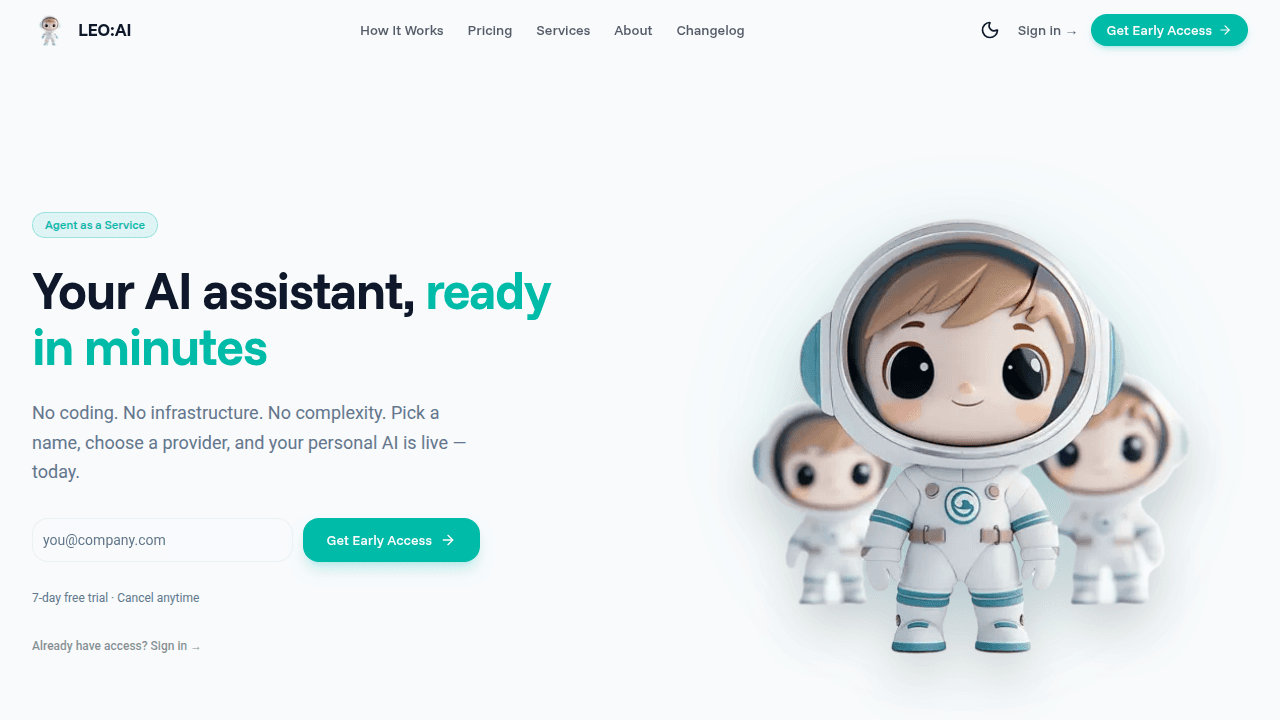
openLEO — your personal AI agent, set up in minutes, no DevOps required.
The DIY path is great if you want to learn. openLEO is for people who want to ship. See pricing →
The cost question nobody's asking
Huang's “AI tokens as salary” proposal reveals the hidden cost of the 100-agent future. At Nvidia's proposed ratio, a $500K engineer might spend $250K in tokens annually. That's a $250K compute budget per person — and Nvidia sells the GPUs those tokens run on.
For the rest of us, the math is radically different:
Starter
One AI instance for personal productivity
Professional
Pre-built agent packages & workflow automation
Most popular
Business
Full power for teams & organizations
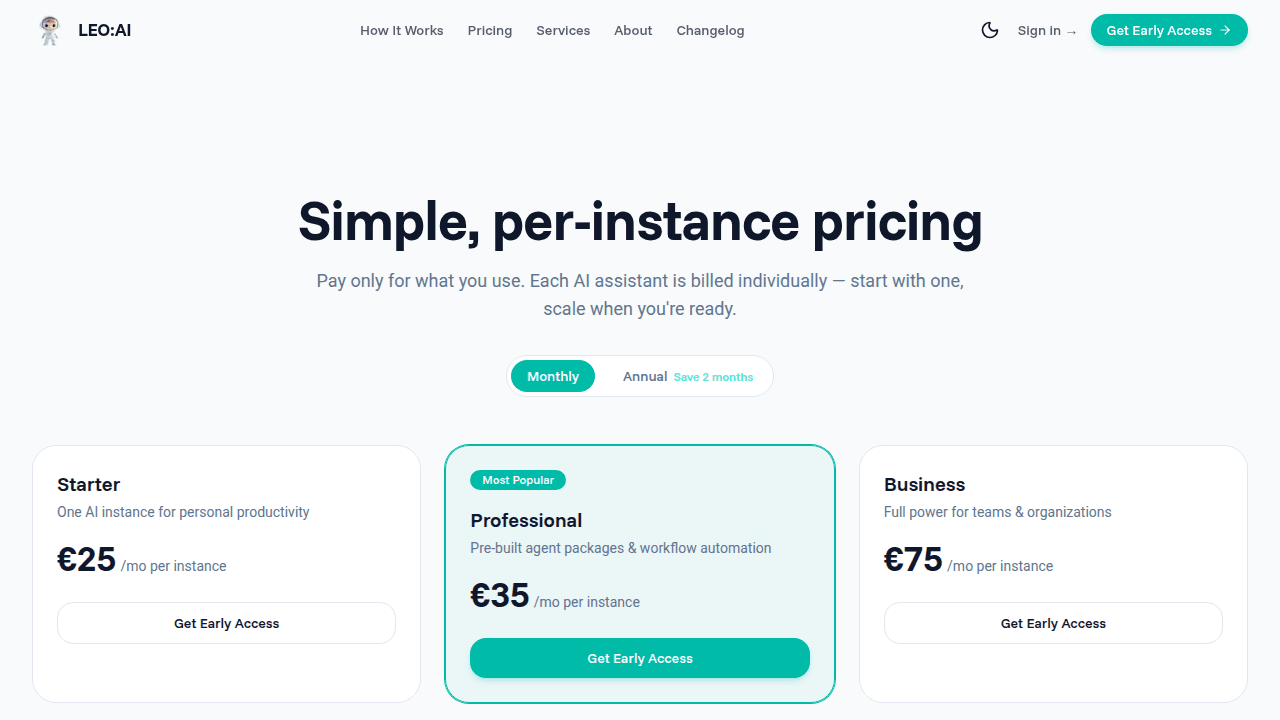
Simple, transparent pricing. Every plan includes a 7-day free trial.
Founding members get 50% off forever with code FOUNDING50. Only 20 spots available. Claim yours →
Compare that to the alternatives: Lindy starts at $49/mo, custom GPTs lack real tool access, and enterprise platforms like CrewAI charge $99+/mo with none of the privacy guarantees.
Who openLEO is built for
openLEO isn't for everyone. It's for people who:
Founders & CEOs
You wear 10 hats and drop 8. Your agent handles the operational ones — email, scheduling, research, reporting — so you focus on building.
Learn more
Solopreneurs
You are the team. Your agent is the multiplier — turning one person into the output of three without the overhead of hiring.
Learn more
Operations leads
You're buried in status reports, follow-ups, and cross-team coordination. Your agent tracks it all and surfaces only what needs you.
Learn more
Developers
CI monitoring, PR reviews, deployment triage, documentation. Your agent handles the toil so you can focus on architecture.
Learn more
Product managers
Backlog grooming, user feedback synthesis, sprint prep, stakeholder updates. Your agent pre-processes it all before you open Jira.
Learn more
Marketing teams
Content pipeline, competitive monitoring, analytics triage, social scheduling. Your agent runs the engine while you steer.
Learn more
For larger organizations, openLEO Enterprise offers custom deployments, dedicated support, and compliance packages tailored for regulated industries.
Ready to start?
7-day free trial on every plan. Set up in minutes. Cancel anytime. Founding members get 50% off forever.
What needs to happen before 100:1 is real
Huang's vision will happen. But not by 2036 at the pace we're going. Three things need to mature:
Orchestration standards
We need shared protocols for how agents communicate, delegate, and resolve conflicts. OpenClaw's multi-agent routing is one approach — LEO:AI's orchestration layer is another. The industry needs convergence.
Runtime observability
You can't govern what you can't see. Agent actions need the same tracing we expect from microservices — but with reasoning-aware instrumentation. NemoClaw's sandboxing is a start.
Accessible infrastructure
If deploying agents requires Kubernetes and a DevOps team, only enterprises will participate. The future Huang describes only works if agents are as easy to deploy as SaaS apps — which is exactly what openLEO provides.
The bottom line
Jensen Huang is right about the direction. 100 agents per employee will happen — probably faster for some roles (content, ops, support) and slower for others (legal, medical, compliance). But the discourse is missing the hard parts: orchestration, memory, privacy, observability, and cost.
You don't need to wait 10 years. You don't need 100 agents. You need one good one — running on your own server, connected to your tools, with memory that persists and skills that matter.
That's what LEO:AI does. That's what openLEO delivers. Not 7.5 million agents. Just yours.
Start with one agent. See what changes.
openLEO gives you a dedicated AI agent on your own server — connected to your email, calendar, Slack, and tools. 7-day free trial, set up in minutes. Founding members get 50% off forever.
Explore openLEO
Related reading
AI Agent for Founders & CEOs
How agents handle founder operational work
AI Agent for Solopreneurs
One person, the output of three
Privacy-First AI Assistant
Why infrastructure isolation matters
No-Code AI Agent
Deploy agents without engineering skills
openLEO vs. Lindy AI
How we compare to other agentic services
openLEO vs. Custom GPTs
Beyond chatbot limitations
Also published on Hashnode. Found this useful? Share it.
Your first AI agent is waiting
7-day free trial · Dedicated server · Set up in minutes · FOUNDING50 for 50% off